ShowOnce · Hackathon Build
Film a task once. The robot does it on a new table.
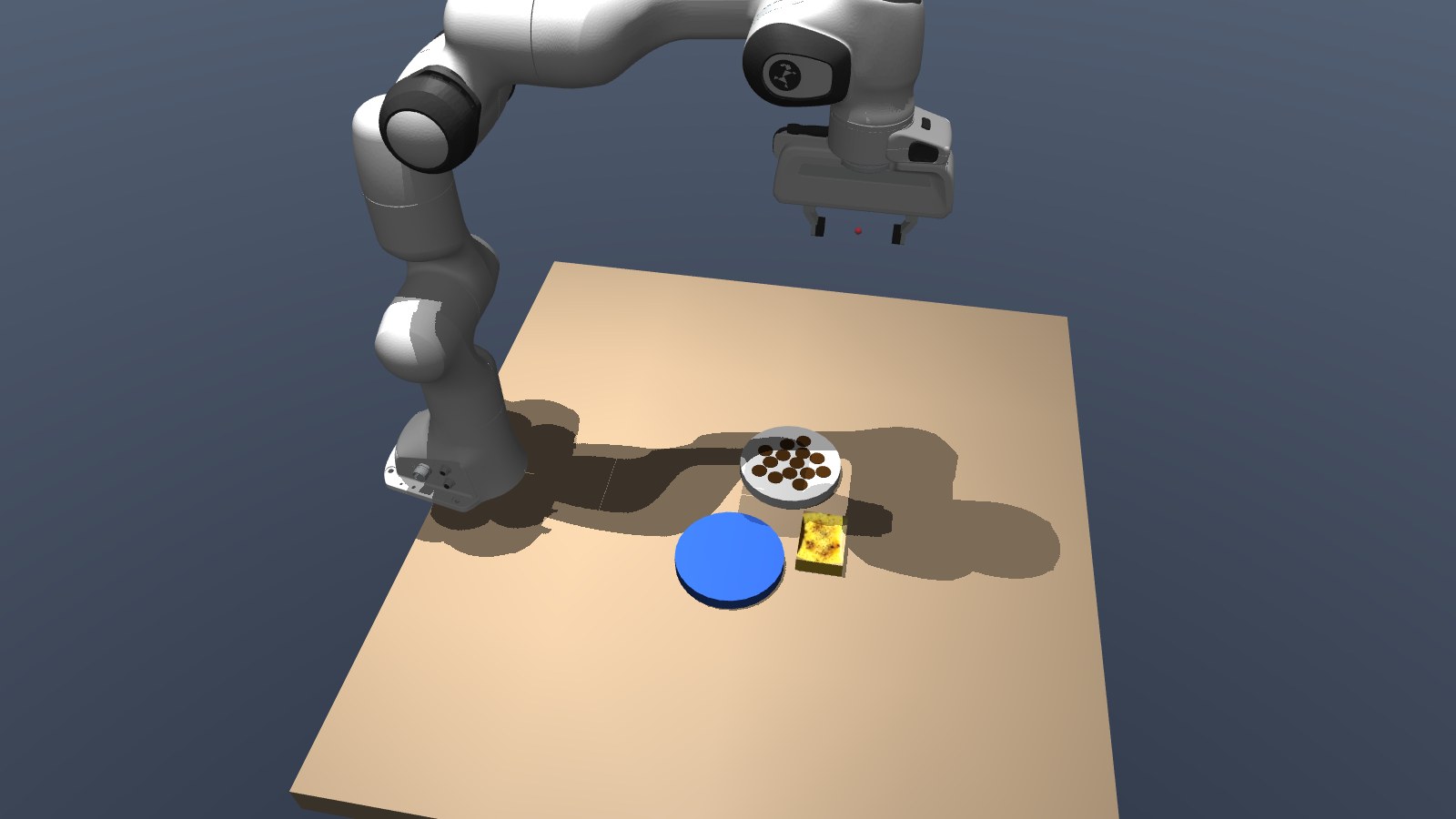
Film a tabletop task once. ShowOnce turns the clip into a layout-independent program, asks you when it is unsure, then performs the task on a shuffled table in a MuJoCo robot simulation and checks its own work.
- Event
- Meta Global AI Developer Hackathon, 2026
- Input
- One phone clip
- Output
- A layout-independent task program
- Scope
- Simulation only
Show it once.
You cannot ship a household robot with every job pre-programmed, and you cannot ask a family to record hundreds of demonstrations. But a person can already teach almost anything by showing it once. ShowOnce is built on that idea: it learns the task, meaning what moved where and in what order, not the motion of the hand. That is why the same program works on a table that looks nothing like the one in the clip.
The clip, then the robot.
Six stages.
Watch
SAM 3.1 tracks each object through the clip. A hand hides an object while it moves, so only the places where objects rested before and after a move are used.
Understand
Each move is explained from geometry (into a container, onto another object, beside one). Muse Spark 1.3 watches the same clip and returns its own reading as schema-checked steps. The two are cross-checked.
Ask
If the readings disagree, or the person wants to add detail, the system talks it through in plain language before anything moves. A plan can only name objects that are really on the table.
Compile
The steps become a task program of ten possible actions, made only of object names and relations. No coordinates are stored, so it stays valid on any layout.
Act
A Franka Panda in MuJoCo performs each step with its own motion on a shuffled table. The robot does not know where things are: it renders its camera and SAM finds each object.
Check
Each step is checked against simulator ground truth, then a second time by looking at the finished table through SAM. A step it sees as missed is run once more.
Two independent checks.
Simulator ground truth alone could be called circular, so the robot also looks. After a run it parks the arm, renders its camera, finds each object with SAM and compares what it sees with every step's goal. Seven demo tasks replay on shuffled tables with every step passing, and SAM locates objects within 3 mm of the simulator's true positions. Steps a top-down view cannot show, such as stirring or pressing, are judged from simulator state, and the report labels which is which.
What it does not do.
Task-level imitation only
It learns what moved where, not dexterous motor skills. Grasps in the simulator are weld constraints.
Simulation, not hardware
Everything runs in MuJoCo. Fluids, cloth and tearing are abstractions, and no real robot has been tried.
Small, controlled scenes
A fixed, roughly top-down camera, a handful of distinctly coloured objects and steady light. Three of the demo clips are real stock footage; the others are AI-generated and have small glitches.
Open source.
Code, demos and technical notes are on GitHub, under the MIT licence. Built for the Meta Global AI Developer Hackathon 2026.