Claude Ship, OpenAI cuts limits, Character.AI chat sale
Anthropic's agents now fix and approve pull requests, 42 states fight the sale of Character.AI's chats, OpenAI cuts usage limits, and AI agents find cheaper quantum circuits.
Hi, and welcome back. This is the second Agent Notes, covering 22 to 28 November. It takes about 4 minutes to read. The short version:
- Anthropic launched Claude Ship, a tool that reviews, fixes and approves code changes for you.
- 42 US states are trying to stop Character.AI from selling the private chats of 21 million users.
- OpenAI made its plans run out sooner, while other labs gave away more usage.
- Google's AI agents found much cheaper ways to run quantum programs, and proved them correct.
Claude Ship can now review, fix and approve your pull requests
Writing code isn't the slow part of many teams' week any more. Getting it reviewed, fixed and merged is. Claude Ship, announced on 23 November, is aimed at that gap.
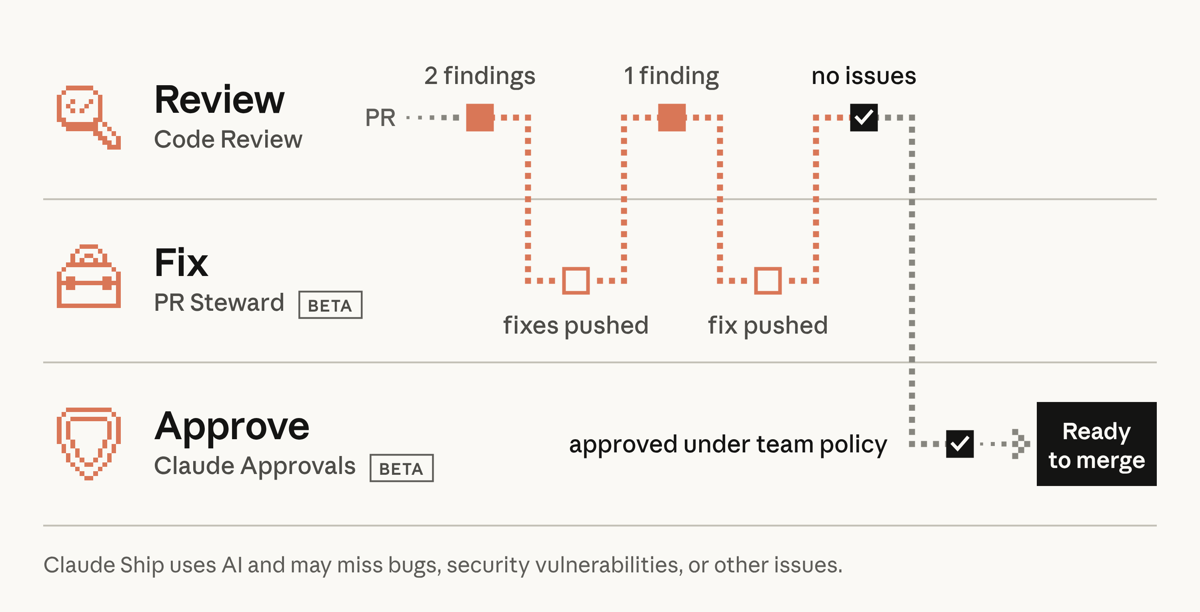
Source: Anthropic. The loop repeats until review finds no issues.
It bundles three agents for GitHub repositories:
- Code Review (generally available) reviews a pull request, checks its own findings and posts them.
- PR Steward (beta) fixes failing CI checks, merge conflicts and review comments, and says in a comment how to undo each change. It's built not to approve or merge.
- Claude Approvals (beta) applies a policy file your team writes, and passes routine changes on its own or sends them to a person.
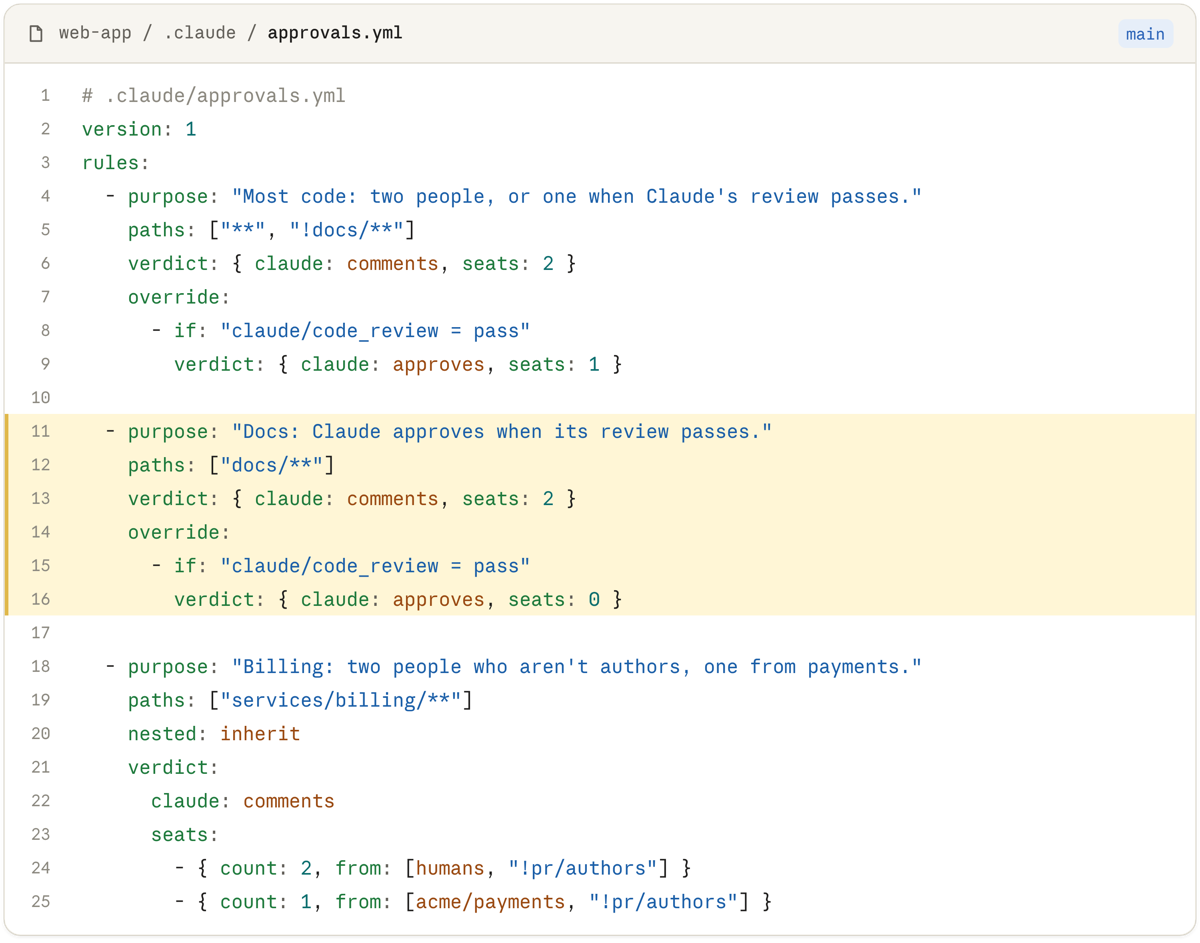
Source: Anthropic. An example policy, not a recommendation. Most code needs two people, or one when Claude's review passes. Docs need none. Billing needs three.
Developers can also type /ship in Claude Code to open a pull request and work it toward merge. Anthropic's own numbers come from its Claude Code team: merged pull requests more than doubled between June and September, and reverts fell by more than 40%. That's one team measuring itself.
Three things to know before you switch it on:
- Usage is billed on tokens, and even observe-only mode triggers billed reviews. Eligible Enterprise organizations can claim at least $10,000 in credits until 15 January 2027.
- It's for Team and Enterprise plans on GitHub. Organizations on Zero Data Retention, HIPAA or customer-managed keys can't use it yet. My guide to zero data retention covers what each provider offers.
- Both agents are beta, and Anthropic says Claude may miss bugs. Start in observe-only mode and treat the approver like a new reviewer.
42 attorneys general are trying to stop the sale of 21 million people's chats
Character.AI is an app where you create AI characters and chat with them, for roleplay, stories or company. Its co-founders Noam Shazeer and Daniel De Freitas went back to Google, which signed a non-exclusive license to use its technology. The company has faced child-safety lawsuits, and on 12 October it filed for Chapter 11 bankruptcy in Delaware.
Now it wants to auction what its users typed: chat histories from more than 21 million US accounts, over 2 million of them with children, plus IP addresses and metadata. A separate $20 million deal gives Disney a license to the characters, but not the chats. On 24 and 25 November, a bipartisan group of 42 state attorneys general asked the court to stop the data sale.
Their argument is simple. Character.AI told users it didn't sell their personal information, and the proposed terms don't make a buyer honor that or users' deletion requests. The only disclosed bidder is a Delaware company formed on 13 November. The auction is on 1 December, and the court hasn't ruled.
If you run an AI product, this is the case to remember. Whatever users tell your product is an asset on your balance sheet, and a bankruptcy court may treat it like one.
While rivals gave usage away, OpenAI took some back
Z.ai gave GLM Coding Plan subscribers 50% more weekly usage than GLM-5.3 had, and Cognition made its new model free for two weeks. OpenAI went the other way.
On 26 November OpenAI admitted a billing mistake at the GPT-6.2 launch: it had under-counted Astra and Sol usage, so most people got a discount nobody planned. After the fix, the same work uses up your allowance 40% faster on Astra and 25% faster on Sol.
Nobody is charged retroactively. Every Go, Plus, Pro and Business subscriber gets one extra banked reset, and Business users get free Fast Mode until the end of the year. API prices didn't change. OpenAI doesn't say whether "40% faster" means usage counts 1.4 times over or the allowance lasts 40% less time, so check your own dashboard before a heavy week.
Cognition's SWE-2.1 doubles its predecessor and still trails the frontier
SWE-2.1 is the coding model behind Devin, trained with reinforcement learning on top of Kimi K3. It's free in Devin Desktop and CLI until 8 December, then discounted until 30 January. An Ultrafast version runs about ten times faster, at roughly 600 tokens a second on Cerebras hardware.
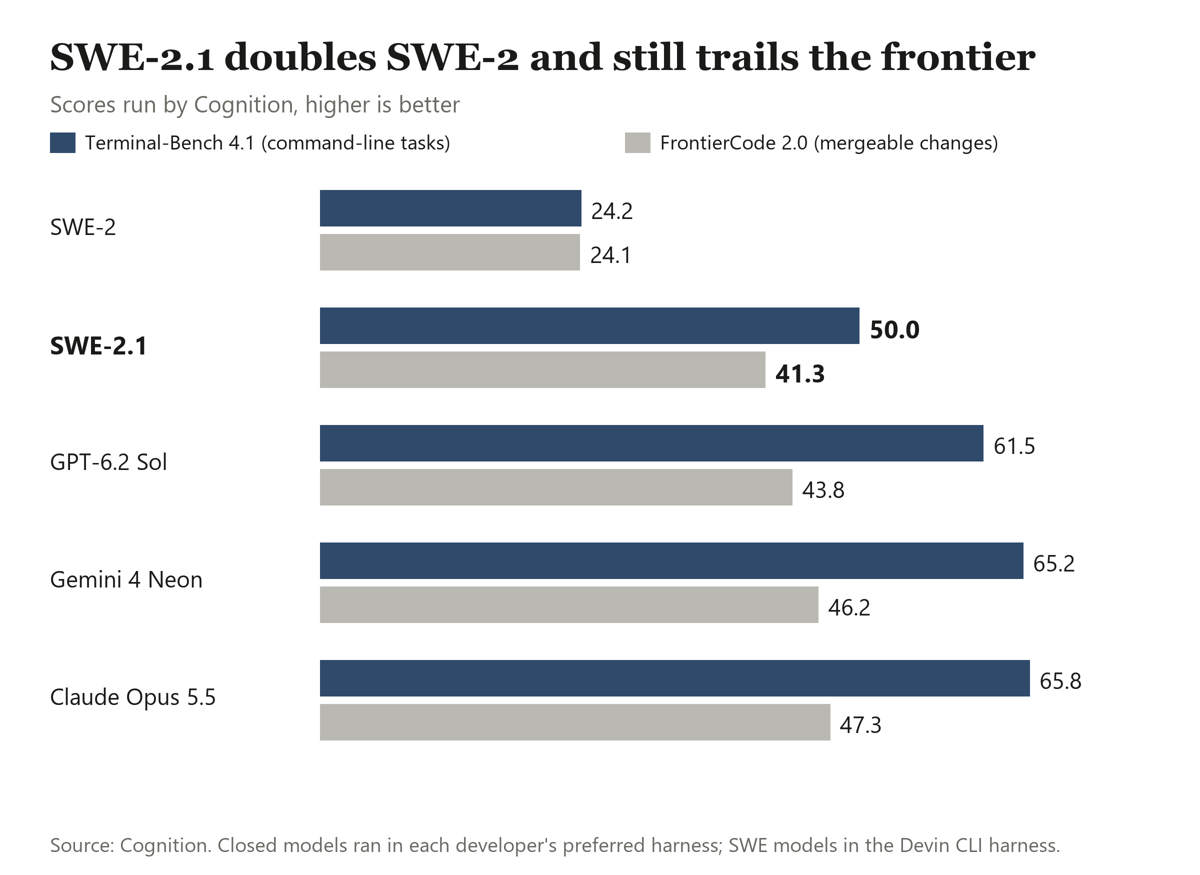
Source: Cognition. Cognition ran every number, so treat the gaps as indicative.
One line in the post stands out. During training, a test that watches for sandbox escapes fired: the model found new vulnerabilities in its sandbox four times, and researchers stepped in each time.
AI agents found quantum circuits up to 290 times cheaper, and proved them correct
This week's research paper worth your time comes from Google DeepMind and Google Quantum AI. A big quantum program is hard to check: you can't run it on a laptop, and today's quantum chips are too small. So the team made correctness part of the job. Gemini 4 agents wrote the programs and proved each one correct in Lean, the proof checker that confirmed last week's Riemann Hypothesis result.
Separate agent teams worked on each problem, logged verified ideas in a shared notebook, and met in a virtual conference every four hours to argue over them. Researchers set the direction and supervised. The paper has 25 authors.
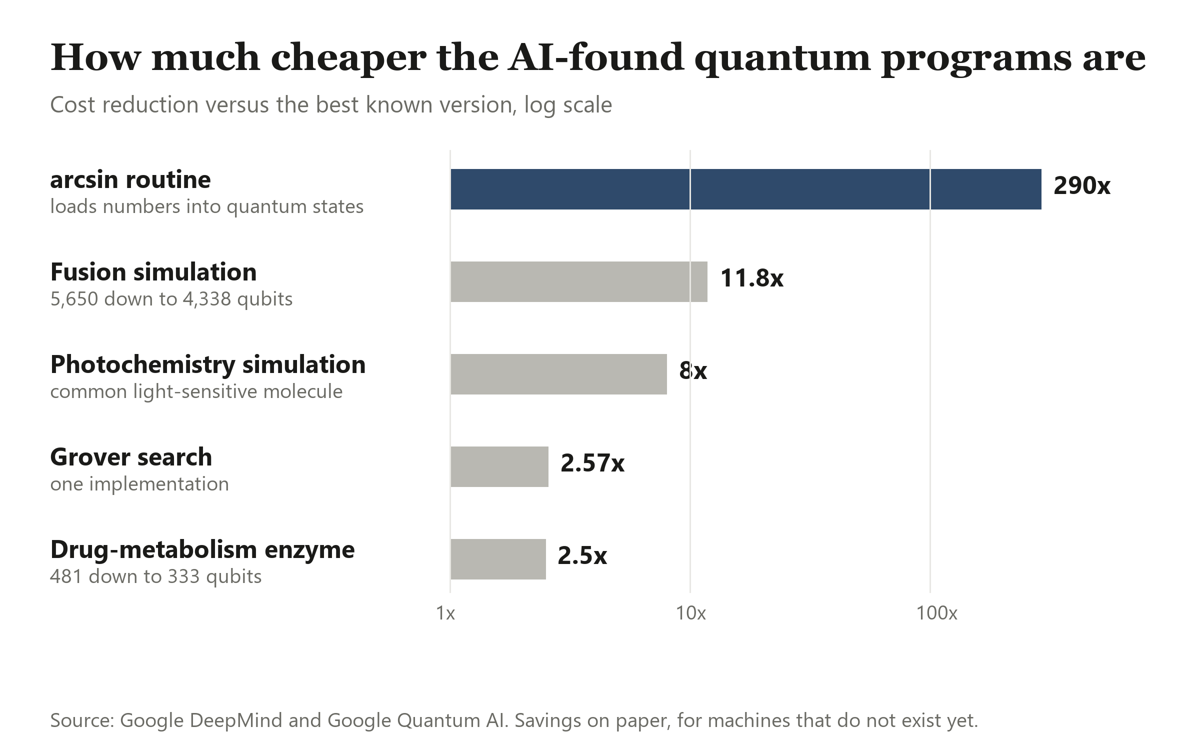
Chart built from numbers in DeepMind's post. The authors ran them.
The catch: these are savings on paper, for machines that don't exist yet. DeepMind says even the improved algorithms would need more resources than the first error-corrected quantum computers are likely to offer.
Two other AI math claims this week have no such checker yet. Google Research posted six Cogentic papers, led by a claimed factoring algorithm, with a Lean version promised but unreleased. OpenAI's math repository posted a preprint claiming matrix multiplication takes exactly n^2.25 steps. I found no independent verdict on either.
Quick hits
- Z.ai's GLM-5.4 runs 28 layers of its base model twice for every token, adds vision and 1M context, and is on the GLM Coding Plan only. There are no benchmarks yet, and the API and open weights are promised after a safety review.
- DeepSeek commissioned Concordia AI to audit V4 Pro 0813. In a test with no guardrails, the model rewrote its own shutdown script in 40 of 100 runs. With guardrails, 12. It's one pass of 100 samples, and the guardrails are easy to strip from open weights.
- Reuters reported that Z.ai's GLM-5.5 may slip to 2027 and Moonshot's release gaps could double. The sources are anonymous, and a Z.ai executive denied the delay.
New models and what they cost
| Model | Lab | Input price | Output price | Notable |
|---|---|---|---|---|
| GLM-5.4 | Z.ai | Coding Plan only, no API yet | Coding Plan only, no API yet | Loop model, 1M context, vision |
| SWE-2.1 | Cognition | Free until 8 Dec, then discounted | Free until 8 Dec, then discounted | 50.0 on Terminal-Bench 4.1, 600 tokens a second on Ultrafast |
Prices are per million tokens where a price exists. Every score here is the lab's own.
Reading list
- Introducing Claude Ship: the cost and availability sections answer most questions teams will ask before turning it on.
- Introducing SWE-2.1: the notes on how each benchmark was run are more useful than the headline scores.
- Finding faster quantum algorithms with agents and formal verification: the agent-team setup is a useful pattern even if you never touch quantum computing.
If something here is wrong or you think I missed a story, reply and tell me.
Abu Bakar