Gemini 4 Neon catches Opus 5.5, plus Anthropic's IPO
Google's new model tops a coding-agent index and some developers now rank it above Opus 5.5. Also: Anthropic's record IPO and a Lean-checked Riemann proof.
Hi, and welcome to the first Agent Notes. Every week I'll send what changed in AI, what it means if you build with it, and a few links worth your time. This one covers 15 to 21 November.
This week, briefly
| Story | What happened |
|---|---|
| Gemini 4 Neon | Google's new model is #1 on the Artificial Analysis Coding Agent Index (58.6), priced at $3 per million input tokens and $15 per million output tokens |
| Anthropic IPO | $81.3B raised at $83 a share, the largest IPO on record |
| Riemann Hypothesis | Levent Alpöge and Claude released a 17-million-line Lean proof; the Lean and Mathlib communities confirmed it a day later |
| GPT-6.2 Astra and Sol | OpenAI's two new models; Astra beats GPT-6 Astra at under a third of the cost per task |
| Inkling 2 Mini | An open-weight model from Thinking Machines that runs on a 32 GB Mac, Apache 2.0 |
The big one: Google is back in the coding race
For a long time, Gemini took a lot of criticism from developers, and for serious coding work most people didn't take it seriously. The bar was Claude, and with Opus 5.5 that bar got high.
I rate Opus 5.5 very highly. For me it fixed most of the problems I kept running into when coding with LLMs. So when people started saying a Google model was level with it, and some said better, I paid attention. That shift is the story of the week.
What Google shipped
Google released Gemini 4 Neon on 18 November. It is the middle model in the Gemini 4 line, priced at $3 per million input tokens and $15 per million output tokens, with a 1M-token context window.
The headline number comes from an independent tester: Neon scored 58.6 on the Artificial Analysis Coding Agent Index, the top score. That index averages implementation, terminal and repository Q&A tasks.
Here is Google's own table against Opus 5.5 and GPT-6.2 Sol. Neon leads most rows. Opus still edges it on the two benchmarks closest to everyday coding: Terminal-bench 4.1 (65.8% against 65.2%) and FrontierCode 2.0 (47.3% against 46.2%).
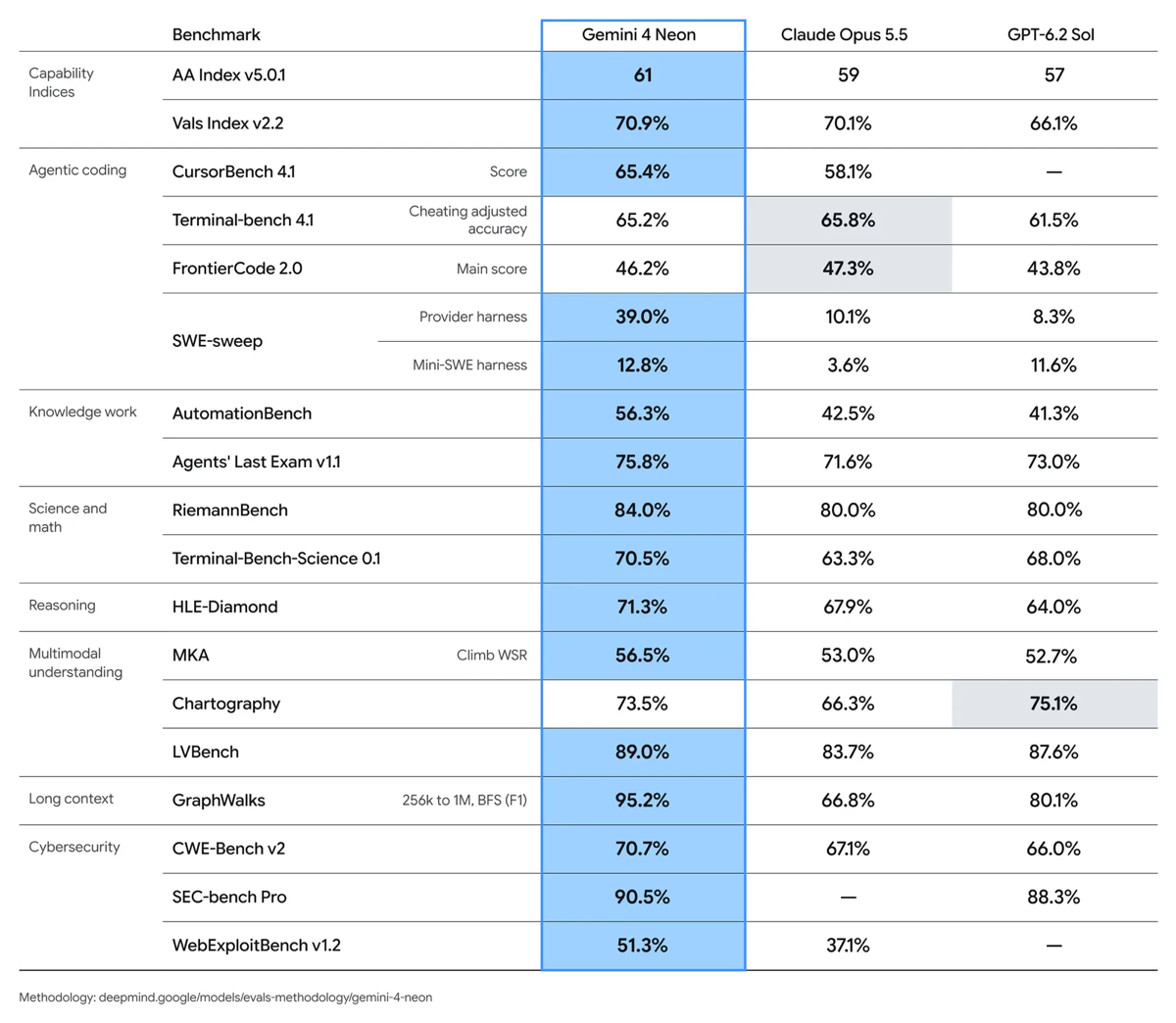
Source: Google. Google ran these numbers.
Price is the other half. On Google's cost chart, Neon at high effort scores 60 on the Artificial Analysis Intelligence Index for under $4 a task. Opus 5.5 needs about $10 a task to reach 59.
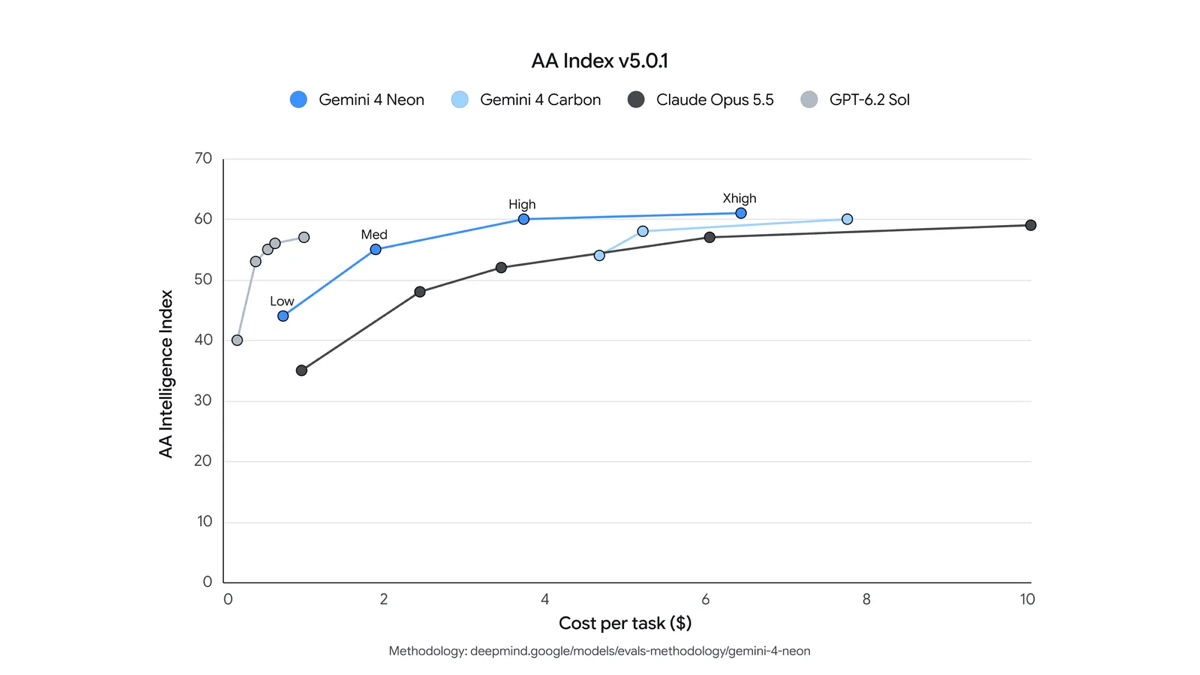
Source: Google.
What developers are saying
- Theo (t3.gg) called Neon an incredible model and posted that Gemini usage in T3 Code is growing exponentially since the launch.
- On Hacker News, the common view was that Neon is roughly level with Opus 5.5 for coding, and very eager to run tasks to the end. Some people put it ahead.
- Opus still gets the nod for frontend work and design taste in most side-by-side posts this week.
- Cost per token is low, but tokens add up. One developer testing Neon as a code reviewer found it slow, and the reviews alone came to $115.78 at list price. Reviewers also say Neon gets wordy at its highest reasoning setting.
The catch: a lot of it is the harness
A harness is the tool a model works inside: what it can do, what it sees, and how it splits up a big job. It matters more than most people think.
Look at the SWE-sweep rows in Google's table. SWE-sweep tests finding and fixing bugs across large codebases. Neon scored 12.8% in a basic harness and 39.0% inside Antigravity, Google's own coding tool. Same model, three times the score. Other models change with their maker's tool too (Opus 5.5 goes from 3.6% to 10.1%), but no other pair gains like Neon and Antigravity.
I'm glad to see this. Antigravity launched last year as Google's own coding tool, yet it shipped with Claude Sonnet as one of its models, and that never sat right with me. Claude Code is built around Claude. Codex is built around OpenAI's models. The lab's own tool should be where its own model works best. Now Google is tuning Gemini for Antigravity, and the product finally makes sense.
So when someone says Neon beats Opus 5.5, ask which tool each one ran in. That question is why I built Agent Bench, which runs the same tasks across agent frameworks and publishes every run.
How Antigravity gets three times more out of the same model deserves more space than a recap has. I'm writing it up as a separate technical post.
Also this week
Anthropic went public
Anthropic sold shares on the stock market for the first time and raised $81.3 billion, the largest IPO on record. Shares were priced at $83 and trade on Nasdaq as ANT. They closed the first day 17% higher, then gave back much of that gain in what CNBC called tech's worst week on Wall Street since 2020.
For people who build on Claude, nothing changes today. Over time, a public company reports numbers every quarter, and its pricing and roadmap decisions get made with that in mind.
Claude helped prove the Riemann Hypothesis, and Lean checked it
The Riemann Hypothesis is a claim about where the zeros of one function sit. It has been open since 1859, it is one of the Clay Millennium Prize problems, and a lot of what we know about prime numbers depends on it.
On 20 November, Levent Alpöge, a mathematician at Anthropic, posted a four-page note saying that he and Claude had found a proof. The proof itself is a Lean library of 17 million lines of code, with no long paper alongside it.
Lean is a proof assistant: a program that checks every logical step of a proof the way a compiler checks code. If the theorem is stated correctly and Lean's kernel accepts the proof, a human reviewer has no gap left to miss.
A day later, the Lean and Mathlib communities issued a joint statement, endorsed by the Lean FRO and the Mathlib Initiative: "We have full confidence that Alpöge's proof of the Riemann Hypothesis is correct." They checked that the proved theorem matches Mathlib's existing RiemannHypothesis statement, using two independent comparison tools. Many people also compiled the library and got the same output, and Lean's kernel plus several independent checkers accepted the proof.
Nobody yet has a human-readable account of the new ideas, and the statement says it looks forward to mathematicians explaining them. Alpöge says the method should also reach the Generalized Riemann Hypothesis, but that part has not been checked.
The timing, the day after the IPO, drew a lot of cynical replies on X. The way the result was checked answers most of them: you don't have to trust Anthropic or Claude, only Lean's kernel.
OpenAI's GPT-6.2 does more with fewer tokens
OpenAI released GPT-6.2 Astra and Sol on 17 November, in ChatGPT, Codex and the API. Astra is the frontier model and Sol is the everyday one. The launch post is mostly about efficiency: every benchmark chart plots score against cost per task.
Here is the data behind two of those charts, each model at its best setting.
Agents' Last Exam v1.1 (multistep professional work)
| Model | Score | Cost per task |
|---|---|---|
| GPT-6.2 Astra (xhigh) | 78.3% | $2.89 |
| Gemini 4 Carbon (high) | 77.4% | $4.60 |
| GPT-6 Astra (max) | 73.1% | $8.99 |
| GPT-6.2 Sol (max) | 73.0% | $1.32 |
| Claude Fable 5.2 (max) | 72.8% | $60.05 |
| Claude Opus 5.5 (max) | 71.6% | $17.57 |
FrontierCode 2.0 (code changes that maintainers would merge)
| Model | Score | Cost per task |
|---|---|---|
| Claude Fable 5.2 (xhigh) | 49.1% | $14.19 |
| Claude Opus 5.5 (max) | 45.5% | $12.82 |
| GPT-6.2 Astra (max) | 44.2% | $5.97 |
| GPT-6.2 Sol (max) | 43.8% | $1.29 |
| GPT-6 Astra (max) | 42.8% | $6.68 |
Cost per task is the tokens a model uses multiplied by the price per token, and OpenAI cut both. Reasoning models bill their thinking as output tokens, so a model that reaches the same answer with less thinking is cheaper even at the same price. On OpenAI's GDPval v2, Astra scores 6.2 points higher than GPT-6 Astra with 22% fewer output tokens. On top of that, Astra's prices dropped 20%, to $8 per million input tokens and $40 per million output tokens, and cached input dropped 60% to $0.40. Sol stays at $2 input and $10 output.
Sol is the one I'd look at. It lands within half a point of Astra on FrontierCode at about a fifth of the cost, so it's the default for most agent work, and Astra is for the tasks where Sol fails. Claude still tops the coding table, at more than twice the price.
These are OpenAI's runs, and other labs' runs differ: Google's table above has Opus 5.5 at 47.3% on FrontierCode, where OpenAI's has 45.5%. Run your own tasks before you move a production workload.
Inkling 2 Mini: a strong open model that fits on a laptop
Thinking Machines released Inkling 2 Mini on 20 November, with full weights on Hugging Face under Apache 2.0. It needs about 20 GB of memory, so it runs on a Mac with 32 GB or more.
Its main technical idea is looping. The model has 26.4B parameters, but only 3.4B are active for each token, and its middle layers run three times per token. That gives it more computation per token without storing more weights.
The lab reports 48.2% on DeepSWE v1.1 and says it leads open models under 100B parameters. Artificial Analysis puts it at 20 on its Intelligence Index, far below the frontier. It's a good local model for private or offline work. It won't replace Neon or Opus.
New models at a glance
| Model | Lab | Input price | Output price | Notable |
|---|---|---|---|---|
| Gemini 4 Neon | $3 | $15 | 58.6 on the AA Coding Agent Index (#1) | |
| GPT-6.2 Astra | OpenAI | $8 | $40 | 78.3% on Agents' Last Exam at $2.89 a task |
| GPT-6.2 Sol | OpenAI | $2 | $10 | 43.8% on FrontierCode 2.0 at $1.29 a task |
| Inkling 2 Mini | Thinking Machines | Free (open weights) | Free (open weights) | 3.4B active params, ~20 GB, Apache 2.0 |
Input and output prices are per million tokens, from the API list prices in the launch posts. Apart from the Artificial Analysis score, the numbers are the labs' own.
Worth reading
- Antigravity subagent docs: the clearest picture I've seen of how a modern coding harness splits work.
- Lean verification of the Riemann Hypothesis: the primary source, short, and clear on what was checked and how.
- Introducing Inkling 2 Mini: worth it for the explanation of looped models alone.
That's the first one. If something here is wrong or you think I missed a story, reply and tell me.
Abu Bakar